
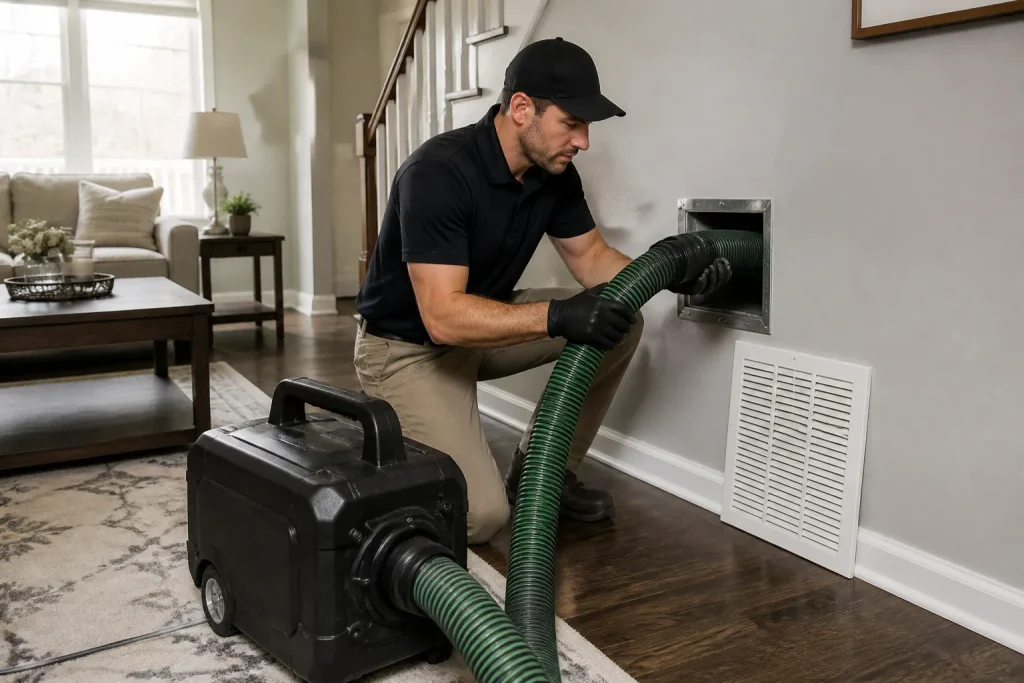
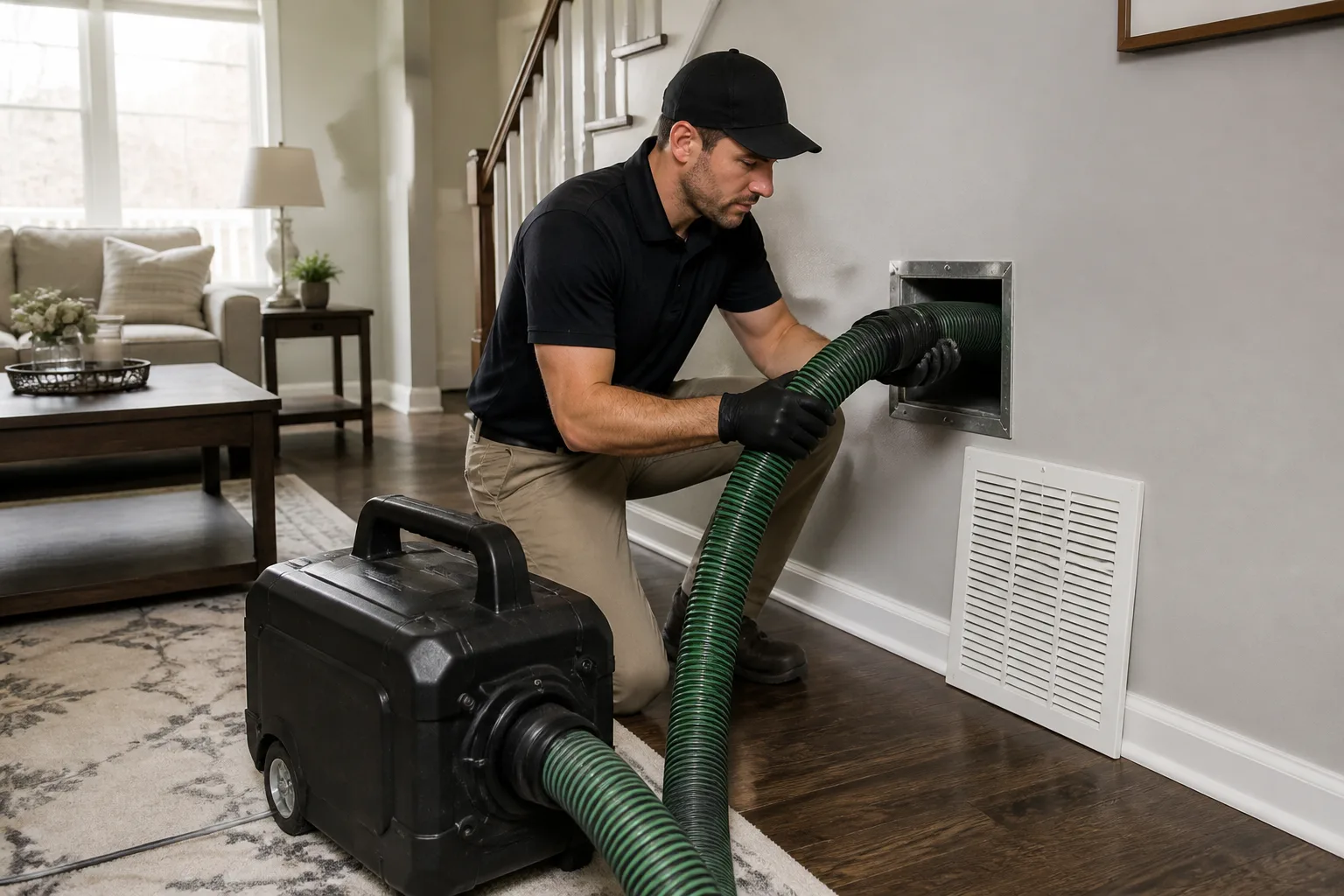
Aprilaire Air Duct Cleaning in St. George: A Homeowner’s Guide
If your home has an Aprilaire ERV, bypass humidifier, or media filter cabinet and the cleaning crew never opened those components, your ducts were cleaned but your air system wasn’t. Most cleaning companies treat the ductwork as the job and everything bolted onto it as scenery. On an Aprilaire-equipped system that leaves the parts most likely to hold moisture, dust, and biological growth untouched. This guide covers what those components are, why each one matters, and what to ask before anyone starts work in your St. George home.
If you’d rather have a professional handle it than climb into the attic yourself, call (888) 848-7351.
What Aprilaire Components Usually Sit Alongside St. George Ductwork?
An Aprilaire system isn’t one product. It’s a family of air quality devices tied into your HVAC and ductwork, and in St. George homes we typically find two or three of them installed together:
- Aprilaire bypass humidifier – a unit mounted on the supply or return plenum with a water panel, a solenoid valve, and a drain line. Common in desert homes that need winter humidity, and the single most overlooked contamination point in the whole system.
- Media filter cabinet – a large box that holds a thick replaceable filter instead of the thin 1-inch filter at the return grille. Effective, but only while the media is actually changed.
- ERV (Energy Recovery Ventilator) – brings filtered fresh air in and exhausts stale air out, transferring heat and moisture between the two streams through a core.
- Fresh-air intake duct – the ductwork that carries outside air to the ERV or to the return. It pulls in whatever the outside air carries, including the fine desert dust that defines St. George.
- Zone dampers and controls – less of an Aprilaire product line, but frequently installed in the same mechanical closet and just as frequently ignored.
Every one of these creates a surface where dust settles or moisture sits. That’s why a cleaning that stops at the duct runs is only part of the story in a St. George home with Aprilaire equipment attached.
Why Is the Bypass Humidifier the Biggest Contamination Risk?
A bypass humidifier’s water panel stays wet whenever the unit runs, and the drain pan beneath it collects whatever drips through. In our experience, that wet environment is exactly what mold and bacteria need, and the humidifier sits on the plenum that feeds air into the ducts. When the water panel gets crusty with mineral scale and the pan doesn’t drain cleanly, spores can be carried straight into the airstream every time the blower runs.
What should happen during a full-system cleaning:
- The water panel is removed and inspected. If it’s scaled, degraded, or shows biological growth, it gets replaced, not rinsed and reinstalled.
- The drain pan and drain line are checked for standing water and cleared if plugged.
- The humidifier housing and the plenum opening it’s mounted to are cleaned and HEPA-vacuumed.
- The unit’s operation and the bypass duct are verified before it’s put back in service.
A humidifier that stays damp and dirty is quietly working against the air quality you’re paying to improve. Ask any St. George cleaning company whether they open the humidifier. If they look puzzled, that tells you something.
Cleaning Around an Aprilaire Media Filter vs. Replacing It
A media filter cabinet holds a pleated filter that’s meant to be replaced on a schedule, typically once or twice a year depending on the filter’s rating and how much dust your St. George home generates. Cleaning around it means working the ducts up to the cabinet, then stopping. The saturated media stays in place, and the airflow it’s supposed to protect keeps passing through a clogged filter. That’s not a cleaning, it’s a vacancy.
An inspection-and-replace approach looks different:
- The media is inspected for loading, bypass gaps, and dust breakthrough on the downstream side.
- The filter slot and cabinet interior are cleaned of debris that bypasses the media.
- The correct replacement media is installed and the cabinet is verified to seal properly against the frame.
- The filter change is recorded so someone in the house knows when it’s due again.
This is why we work with Aprilaire’s product ecosystem: matching the replacement media to the cabinet and the home’s needs beats guessing, and it means the filter actually does the job the system was installed for. If your media filter hasn’t been touched since the last cleaning, that’s worth a phone call to (888) 848-7351.
How Should an ERV Core Be Cleaned, and Why Standard Vacuums Miss It?
An ERV uses a heat-exchange core with narrow passages between stacked plates. A standard duct cleaning vacuum pulls air through the duct runs, but it can’t pass through the tiny channels inside the core because the core is a separate, densely packed component. The core has to come out, be cleaned with a method suited to its construction, and be reinstalled correctly.
What that process should include:
- The unit is powered down and the core removed without damage.
- The core is cleaned according to the manufacturer’s method, not blasted with high-pressure air that can crush the plates.
- The core’s filter screens and any pre-filters are cleaned or replaced.
- The cabinet, blower wheel, drain pan, and duct connections are cleaned and HEPA-vacuumed while the core is out.
- The core is reinstalled, the unit is verified, and airflow is checked.
We use Nikro HEPA vacuums and Rotobrush contact-cleaning equipment on St. George jobs because those tools reach surfaces a shop vac can’t, and they contain the dust instead of dispersing it into the room where you’re standing. That matters more with a core, not less.
What Should You Ask a Cleaning Company Before They Touch an Aprilaire System?
Ask these five questions before anyone unpacks a vacuum. The answers tell you whether the company understands what you have or is just running a duct cleaning routine:
- Do you inspect and clean Aprilaire humidifier components, including the water panel and drain pan?
- Will you inspect my media filter cabinet and advise on replacement, rather than clean around it?
- How do you clean an ERV core, and will you remove it to do it properly?
- What equipment do you use, and is any of it HEPA-filtered with a sealed exhaust?
- Do you offer duct repair and sealing, or only cleaning? Leaky ducts undo a cleaning faster than dust does.
That last question is the one most St. George homeowners forget. Cleaning removes buildup; sealing keeps the air from sneaking in and out through joints and gaps. If a company can’t explain the difference, it probably doesn’t do repair work. There’s no shame in a company that specializes, only in one that pretends to.
When to Call a Pro
Some parts of a full-system service are doable by a careful homeowner, like checking the media filter and pulling the humidifier’s water panel for a visual. But the moment you’re reaching into a plenum, handling a heat-exchange core, or climbing into an attic where the return duct is buried under insulation, it’s time to call a pro. An ERV core is delicate enough to ruin with one wrong move, and the cost of a replacement core is far more than the cost of having it done correctly.
If you’re in St. George and the symptoms suggest your whole air pathway needs attention, we do that work. Related services in St. George include air duct cleaning, dryer vent cleaning, HVAC cleaning, and duct repair and sealing.
The Bottom Line
Aprilaire equipment makes a home’s air system better, but it also adds components that need to be part of any cleaning job: the humidifier’s water panel and drain pan, the media filter cabinet and its media, and the ERV core. A cleaning crew that never opens those parts leaves the most contamination-prone surfaces untouched. Ask the five questions above, insist on proper equipment, and treat the whole air pathway as one system.
There’s no sales pitch needed here, just practical advice. If you’re in St. George and need help, St. George Air Duct Cleaning Pros offers free estimates – call (888) 848-7351. We answer 24/7, with fast dispatch from 7am to 7pm, Sunday through Friday.
Frequently Asked Questions
Not always. Standard duct cleaning often skips the humidifier unless you specifically ask. A proper full-system cleaning includes inspecting and cleaning the humidifier’s water panel, drain pan, and housing. Call (888) 848-7351 for an estimate – estimates are free.
Most ERV manufacturers recommend cleaning the core roughly every 6 to 12 months, depending on dust levels in your home. In St. George, where fine dust is a constant, we lean toward the shorter end and check the pre-filters more frequently. Call (888) 848-7351 to schedule an inspection.
No. A media filter is designed to be replaced, not cleaned. Washing or blowing it out can damage the pleats and reduce its effectiveness. Check it, replace it on schedule, and have the cabinet inspected during a full cleaning. Call (888) 848-7351 with questions.
Because the core’s internal passages are too narrow and densely packed for duct cleaning air to travel through. The core has to be removed and cleaned separately using a method suited to its construction. Call (888) 848-7351 to have it done right.
Written by the team at St. George Air Duct Cleaning Pros.
Need Air Duct Cleaning Help?
Call St. George Air Duct Cleaning Pros - the local pro we connect you with is licensed and insured, with free written estimates in St. George.
(888) 848-7351